
Ewer
Unknown Artist
probably 18th–19th century
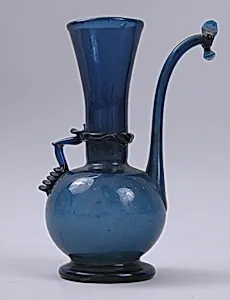
Medium
Glass; free blown with applied decoration
Dimensions
H. 6 7/16 in. (16.4 cm) Max. W. (including spout) 4 3/8 in. (11.1 cm) Max. Diam. 3 1/16 in. (7.8 cm)
Classification
Glass
Department
Islamic Art
Museum
Metropolitan Museum of Art, New York, NY
Credit
Gift of Samuel L. M. Barlow, 1883
Accession Number
83.6.27
Rights
Public Domain
Art Historical Context
This elegant glass ewer, dating to the 18th or 19th century, exemplifies the refined craftsmanship of Islamic glassmaking. Standing just over 6 inches tall with a graceful spout and handle, it was designed for pouring liquids like water or scented beverages, essential in daily life and hospitality rituals across the Islamic world. Its petite dimensions—maximum width of 4⅜ inches including the spout—made it both functional and portable, a testament to the balance of form and utility prized by artisans. Crafted using the free-blown technique, the vessel was shaped by blowing molten glass into a bubble without a mold, allowing for organic, fluid contours. Applied decoration—likely trails of glass or colorful threads—was meticulously added while hot, creating textured patterns that catch the light and highlight the material's translucency. This method, widespread in regions from the Ottoman Empire to Persia, showcased technical virtuosity and aesthetic restraint, often evoking the natural world's elegance without figurative motifs, in keeping with Islamic aniconism. A gift to the Metropolitan Museum of Art in 1883 from Samuel L. M. Barlow, this ewer offers a window into everyday luxury from a vibrant era of Islamic art, reminding us how humble objects embodied cultural sophistication.