
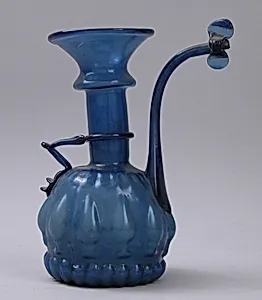
Ewer
Unknown Artist
probably 18th–19th century
Medium
Glass; mold blown and applied decoration, tooled on the pontil
Dimensions
H. 6 7/8 in. (17.4 cm) Diam. 3 9/16 in. (9 cm)
Classification
Glass
Department
Islamic Art
Museum
Metropolitan Museum of Art, New York, NY
Credit
Gift of Henry G. Marquand, 1883
Accession Number
83.7.233
Rights
Public Domain
Art Historical Context
This elegant ewer, likely crafted in the 18th or 19th century, the refined glassmaking traditions of the Islamic world. Standing just under 7 inches tall with a diameter of about 3 ½ inches, it served as a practical vessel for pouring water, often used in rituals of purification or daily ablutions. Housed in the Metropolitan Museum of Art's of Islamic Art, it was generously gifted by Henry G. Marquand in 1883, highlighting early Western appreciation for Eastern artistry. The ewer's medium—glass formed through mold blowing, applied decoration, and tooling on the pontil—showcases sophisticated techniques that were hallmarks of Islamic glass production. Mold blowing created textured patterns by inflating hot glass into a mold, while applied elements like handles or trails were added and tooled for precision. The pontil mark, left from the glassblower's iron rod, adds an authentic touch of the artisan's hand. These methods, evolved over centuries from earlier Islamic innovations, allowed for both functionality and subtle ornamentation without relying on costly enameling. Though the artist remains unknown, this ewer reflects the enduring cultural importance of glassware in Islamic societies, blending utility with aesthetic grace. Visitors can admire how such objects bridged everyday life and artistry, preserving techniques that influenced global ceramics and design.