
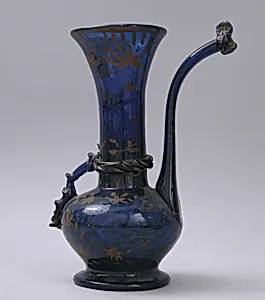
Ewer
Unknown Artist
probably 18th–19th century
Medium
Glass; blown with applied decoration, tooled on the pontil, cold-painted
Dimensions
H. 7 5/16 in. (18.6 cm) Diam. 3 1/4 in. (8.2 cm)
Classification
Glass
Department
Islamic Art
Museum
Metropolitan Museum of Art, New York, NY
Credit
Gift of Henry G. Marquand, 1883
Accession Number
83.7.247
Rights
Public Domain
Art Historical Context
This elegant ewer, a small pitcher likely used for pouring water or rosewater in daily rituals or hospitality settings, exemplifies the refined glassmaking traditions of the Islamic world during the th–19th century Standing just over 7 inches tall with a graceful spout and flared base, it was crafted using free-blown glass techniques, where molten glass is shaped by blowing air through a tube. Applied decoration—trails or threads of glass added while hot—enhances its form, while tooling on the pontil (the rod used to hold the piece during finishing) creates precise details at the base. The final touch of cold-painting, applied enamels fired at lower temperatures, adds vibrant colors without altering the glass's transparency. In Islamic art, such vessels highlight the region's mastery of glassblowing, a craft perfected since medieval times in centers like Syria, Egypt, and Persia. Ewers like this were prized for their functionality and beauty, often featuring in opulent households or religious contexts. Though the artist remains unknown, the techniques reflect a continuity of innovation, blending utility with aesthetic delight. Donated to the Metropolitan Museum of Art in 1883 by Henry G. Marquand, this piece invites us to appreciate the subtle artistry of everyday objects from a vibrant cultural heritage.