
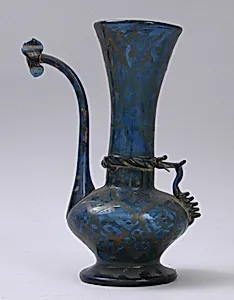
Ewer
Unknown Artist
probably 18th–19th century
Medium
Glass; blown with applied decoration, tooled on the pontil, cold-painted
Dimensions
H. 6 7/8 in. (17.4 cm) Diam. 3 3/16 in. (8.1 cm)
Classification
Glass
Department
Islamic Art
Museum
Metropolitan Museum of Art, New York, NY
Credit
Gift of Henry G. Marquand, 1883
Accession Number
83.7.246
Rights
Public Domain
Art Historical Context
This elegant ewer, likely crafted in the 18th or 19th century, exemplifies the refined glassmaking traditions of the Islamic world. Standing just under 7 inches tall, this small vessel—used for pouring water or liquids in daily rituals or hospitality—was both functional and decorative. Housed in the Metropolitan Museum of Art's Art department, it entered the collection in 1883 as a gift from Henry G. Marquand reflecting early Western fascination with Eastern decorative arts. The ewers showcases masterful techniques: glass blown into shape, then adorned with applied decoration and tooled details on the pontil mark—a remnant of the glassblower's rod. Cold-painting, where enamels were added after cooling without firing, allowed vibrant colors and intricate designs to endure everyday use. These methods highlight Islamic artisans' ingenuity, blending utility with artistry in a medium prized since medieval times. Though the artist remains unknown, this piece captures the cultural importance of glassware in Ottoman or Persian-influenced regions, where such objects graced homes and mosques. Its delicate form invites visitors to appreciate the anonymous craft that elevated the ordinary into the exquisite.