
Ewer Design
Classification
Department
Smithsonian Collection
Museum
Smithsonian American Art Museum
Credit
Purchased for the Museum by the Advisory Council
Accession Number
1921-6-411-66
Rights
Public Domain
About this artwork
Research in Progress
Art Historical Context
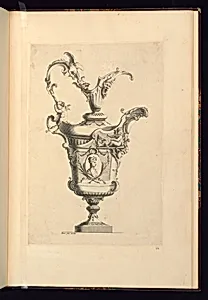
Jean-Bernard Turreau a French artist active from 1672 to 1731, crafted this intriguing *Ewer Design* during an era when France led Europe in opulent decorative arts under Louis XIV. As a print in the Smithsonian American Art Museum collection, it likely served as a pattern for silversmiths or metalworkers, capturing the grandeur of the late Baroque period. Ewers—elegant pitchers used for serving water or wine—were status symbols in affluent households, Turreau's design reflects the meticulous ornamentation prized by the French court. Though the exact date and medium remain under research, the print's classification highlights its role in disseminating intricate motifs to artisans across workshops. Such designs bridged fine art and craft, influencing luxury goods from Paris to international markets. Turreau's work exemplifies how prints democratized high-style decoration, allowing far-flung creators to replicate French elegance. Acquired through the Museum's Advisory Council, this piece invites us to ponder the global reach of French design traditions. Ongoing research promises to unveil more about Turreau's techniques and legacy, making *Ewer Design* a captivating study in historical craftsmanship. (198 words)