
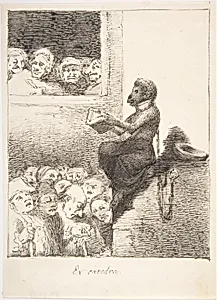
Ex Cathedra ("ex catedra")
1807–45
Medium
Pen and dark brown ink with some brush and gray-brown wash on off-white paper
Dimensions
7-1/8 x 5-1/8 in. (18.1 x 13.0 cm)
Classification
Drawings
Department
Drawings and Prints
Museum
Metropolitan Museum of Art, New York, NY
Credit
Dodge Fund, 1939
Accession Number
39.29.17
Rights
Public Domain
Tags
Art Historical Context
Leonardo Alenza y Nieto’s *Ex Cathedra* (ca. 1807–45) is a delightful gem from the Metropolitan Museum of Art’s Drawings and Prints collection, acquired through the Dodge Fund in 9. This intimate drawing, measuring just 7-1/ x 5-1/8 inches, employs pen and dark brown ink with brush and gray-brown wash off-white paper—a technique favored by 19th-century Spanish artists for its precision and expressive shading. Alenza, a Madrid-based painter and draughtsman active during Spain’s Romantic era, was renowned for his contributions to *costumbrismo*, a movement celebrating everyday Spanish customs through witty, observational scenes. The title *Ex Cathedra*—Latin for “from the chair,” evoking authoritative papal decrees—hints at a satirical nod to scholarly or ecclesiastical pomp. Featuring men and women amid books, the composition likely captures a humorous domestic or intellectual gathering, blending caricature with keen social insight. Alenza’s fluid ink lines and soft washes bring vivacity to his subjects, highlighting the textures of clothing and the weight of tomes. As a window into early 19th-century Spanish life, this work showcases Alenza’s talent for infusing genre drawings with cultural commentary, making it a standout example of how modest sketches could critique authority with charm and finesse. Visitors will appreciate its blend of technical mastery and playful spirit.
About the Artist
Leonardo Alenza y Nieto · 1807–1845
Leonardo Alenza y Nieto (1807–1845) was a Spanish painter and caricaturist whose brief life produced a body of work remarkable for its satirical wit, psychological penetration, and painterly freedom. Born in Madrid, he trained at the Real Academia de Bellas Artes de San Fernando, the preeminent institution for artistic education in Spain, where he absorbed the technical foundations of academic pai...