
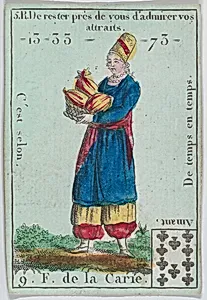
F. de la Carie from playing cards "Jeu d'Or"
Medium
Etching and hand coloring (watercolor)
Dimensions
3 3/16 × 2 1/16 in. (8.1 × 5.3 cm)
Classification
Prints|Ornament & Architecture
Department
Drawings and Prints
Museum
Metropolitan Museum of Art, New York, NY
Credit
Gift of the Estate of James Hazen Hyde, 1959
Accession Number
59.654.14(13)
Rights
Public Domain
Tags
Art Historical Context
This delicate etching from the "Jeu d'Or" playing card deck captures the figure of F. de la Carie, a portrait likely intended to represent a fashionable or notable woman of the period. Created anonymously in 18th-century France, the card belongs to a set that blended entertainment with refined visual culture. Such decks often featured elegantly dressed figures, serving both as tools for games and as miniature works of art that reflected contemporary tastes in portraiture and costume. Measuring just over three inches tall, the print demonstrates the period’s mastery of etching combined with hand-applied watercolor. The fine lines of the etching provide crisp detail, while the delicate coloring brings warmth and individuality to the figure. These techniques allowed card makers to produce affordable yet visually appealing objects that circulated widely among French society. Today preserved at the Metropolitan Museum of Art, this small card offers a charming glimpse into the decorative arts of the Enlightenment era, when even everyday items like playing cards could carry artistic and cultural significance.
About the Artist
Anonymous, French, 18th century · 1700–1800
The artist known as Anonymous, French, 18th century, represents a collective of unidentified talents active roughly between 1700 and 1800, a period of profound artistic evolution in France from the opulent Rococo to the austere dawn of Neoclassicism and Revolutionary fervor. Little is documented about their personal training or mentors, as their anonymity obscures individual biographies, though th...