
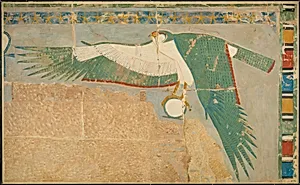
Facsimile of a falcon protecting the king
ca. 1479–1458 B.C.
Medium
Tempera on paper
Dimensions
H. 74 cm (29 1/8 in); w. 121 cm (47 5/8 in) scale 1:1 framed: h. 30 1/4 in; w. 49 in
Classification
Facsimile, Hatshepsut-Temple
Period
New Kingdom
Department
Egyptian Art
Museum
Metropolitan Museum of Art, New York, NY
Credit
Rogers Fund, 1930
Accession Number
30.4.139
Rights
Public Domain
Tags
Art Historical Context
This facsimile captures a striking scene from ancient Egypt’s New Kingdom, Dynasty 18, when royal power was closely tied to divine protection. Created around 1479–1458 B.C., the original wall painting likely adorned a tomb or temple, showing a majestic falcon—symbol of the god Horus—spreading its wings over the pharaoh. Such imagery reinforced the belief that the king was under the constant guardianship of the gods, ensuring order and legitimacy on earth. Charles K. Wilkinson produced this 1:1 scale copy in tempera on paper for the Metropolitan Museum of Art, allowing modern viewers to study the delicate brushwork and vibrant pigments of the original without traveling to Egypt. Facsimiles like this one played a vital role in preserving Egyptian art at a time when many monuments faced damage or restricted access. The work highlights the Met’s long tradition of documenting ancient Egyptian painting techniques, offering visitors an intimate glimpse into the symbolic language and artistic mastery of one of Egypt’s most celebrated eras.
About the Artist
Charles K. Wilkinson · 1897–1986
Charles K. Wilkinson (1897–1986), born Charles Kyrle Wilkinson in London on October 13, 1897, was the son of Horace W. Wilkinson, a stained-glass window maker, and Frances Adkins. Serving in World War I, he honed his artistic skills at the Slade School of Fine Art, University College London, where the influential director Henry Tonks shaped the rigorous training of a generation of draughtsmen. In ...