
The Goddess Nekhbet, Temple of Hatshepsut
ca. 1479–1458 B.C.
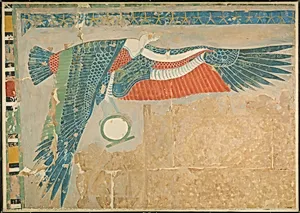
Medium
Tempera on paper
Dimensions
facsimile: h. 75 cm (29 1/2 in); w. 106 cm (41 3/4 in) scale 1:1 framed: h. 77.9 cm (30 11/16 in); w. 109.2 cm (43 in)
Classification
Facsimile, Hatshepsut-Temple, Nekhbet
Period
New Kingdom
Department
Egyptian Art
Museum
Metropolitan Museum of Art, New York, NY
Credit
Rogers Fund, 1930
Accession Number
30.4.138
Rights
Public Domain
Tags
Art Historical Context
Behold the striking facsimile *The Goddess Nekhbet, Temple of Hatsheps*, a masterful reproduction of an ancient Egyptian wall painting from the New Kingdom's Dynasty 18 (ca. 1479–1458 B.C.). Crafted by Egyptologist Charles K. Wilkinson using tempera on paper at precise 1:1 scale (75 x 106 cm), this piece captures the iconic striding pose of Nekhbet, the vulture goddess and protector of Upper Egypt and the pharaohs. Displayed in the Metropolitan Museum of Art's Egyptian Art department (acquired via Rogers Fund, 1930), it evokes the grandeur of Hatshepsut's mortuary temple at Deir el-Bahri. Nekhbet, often depicted with outstretched wings in a dynamic "Walk Like an Egyptian" stance, symbolized maternal protection and royal legitimacy. During Hatshepsut's reign—one of Egypt's few female pharaohs—this imagery reinforced her divine right to rule, blending political power with mythology in the temple's vibrant reliefs. The original artwork's bold colors and hierarchical proportions highlight New Kingdom artistry, where gods and rulers strode forward in eternal vigilance. Wilkinson's technique preserves these hues and details with scientific accuracy, offering visitors an immersive glimpse into ancient rituals without the fragility of originals. A testament to conservation and scholarship, it invites you to ponder Nekhbet's watchful gaze over 3,500 years of history.
About the Artist
Charles K. Wilkinson · 1897–1986
Charles K. Wilkinson (1897–1986), born Charles Kyrle Wilkinson in London on October 13, 1897, was the son of Horace W. Wilkinson, a stained-glass window maker, and Frances Adkins. Serving in World War I, he honed his artistic skills at the Slade School of Fine Art, University College London, where the influential director Henry Tonks shaped the rigorous training of a generation of draughtsmen. In ...