
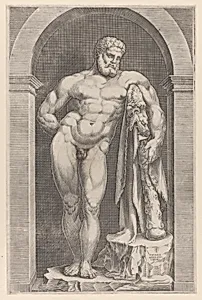
Farnese Hercules
1552–88
Medium
Engraving
Dimensions
Plate: 13 7/16 × 8 3/4 in. (34.2 × 22.2 cm) Sheet: 13 5/8 × 8 15/16 in. (34.6 × 22.7 cm)
Classification
Prints
Department
Drawings and Prints
Museum
Metropolitan Museum of Art, New York, NY
Credit
The Elisha Whittelsey Collection, The Elisha Whittelsey Fund, 1949
Accession Number
49.97.533
Rights
Public Domain
Tags
Art Historical Context
Welcome to the Metropolitan Museum of Art's Drawings and Prints department, where we showcase the *Farnese Hercules*, masterful 16th-century engraving by Italian artists Mario Cartaro and Ghisi (ca. 1552–88). This print captures the ancient Roman statue of Hercules, the mighty hero famed for his twelve labors, depicted in a dynamic pose of weary triumph after his final trial. Measuring about 13½ by 8¾ inches on the plate, the work exemplifies the Renaissance fascination with classical antiquity, bringing the grandeur of a monumental marble sculpture—originally discovered in the Baths of Caracalla—into intimate, reproducible form. Engraving, the medium here, was revolutionary in the 1500s, allowing precise lines and rich tonal contrasts through incised metal plates inked and pressed onto paper. Ghisi, a leading Mannerist engraver known for his intricate reproductive prints, and Cartaro, his contemporary, skillfully rendered the statue's muscular male nude, emphasizing anatomical idealization and heroic vitality. These tags—*Male Nudes* and *Hercules*—highlight its celebration of the male form as a symbol of strength and beauty, echoing Greco-Roman ideals revived during the Renaissance. Part of The Elisha Whittelsey Collection (acquired 1949), this print democratized access to masterpieces, influencing artists and collectors across Europe. Stand before it and feel the timeless power of Hercules, a testament to art's enduring bridge between eras.