
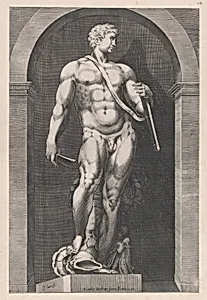
Speculum Romanae Magnificentiae: Perseus
late 16th century
Medium
Engraving
Dimensions
sheet: 14 x 9 7/16 in. (35.5 x 24 cm) mount: 17 11/16 x 12 11/16 in. (45 x 32.2 cm)
Classification
Prints
Department
Drawings and Prints
Museum
Metropolitan Museum of Art, New York, NY
Credit
Harris Brisbane Dick Fund, 1941
Accession Number
41.72(2.114)
Rights
Public Domain
Tags
About this artwork
[Research in progress for Speculum Romanae Magnificentiae: Perseus by Claudio Duchetti|Giacomo Lauri, late 16th century]
Art Historical Context
Discover the captivating *Speculum Romanae Magniae: Perseus*, engraving from the late 16th century by Claudio Duchetti and Giacomouri. This print belongs to the renowned *Speculum Romanaeificentiae* (Mirror of Roman Magnificence), a series produced in Rome that celebrated the city's ancient grandeur through detailed depictions of ruins, monuments, and mythological scenes. Featuring the hero Perseus—famed in classical lore for slaying Medusa and rescuing Andromeda—this work reflects the Renaissance fascination with Greco-Roman myths, blending antiquity with contemporary artistic revival. Engraved on a modest sheet measuring 14 x 9 7/16 inches, the medium allowed for precise lines and intricate details, making high-quality reproductions accessible to collectors across Europe. Duchetti and Lauri's collaborative efforts epitomized the bustling Roman print trade, where engravings served as affordable "souvenirs" of the Eternal City's splendor, fueling the Grand Tour and scholarly interest in classical heritage. Housed in the Metropolitan Museum of Art's Drawings and Prints department (Harris Brisbane Dick Fund, 1941), this piece invites us to ponder Rome's enduring legacy. Imagine 16th-century viewers poring over it, bridging myth and history in a single, elegant image.
About the Artist
Claudio Duchetti|Giacomo Lauri ( |Italian) · |1565 – |1585
|Italian, active Venice and Rome, ca. 1565–died ca. 1585