
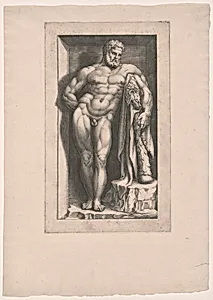
The Farnese Hercules
c. 1577
Medium
Engraving in black on cream laid paper
Dimensions
Plate: 36.4 × 22 cm (14 3/8 × 8 11/16 in.); Sheet: 50 × 35.8 cm (19 11/16 × 14 1/8 in.)
Classification
Department
Prints and Drawings
Museum
Art Institute of Chicago
Accession Number
264799
Rights
Public Domain
Art Historical Context
Behold *The Farnese Hercules*, a masterful engraving by the Italian artist Giorgio Ghisi, created around 1577. Ghisi, a leading figure in 16th-century printmaking, captured the iconic ancient Roman marble statue—itself a Hellenistic copy depicting the weary hero resting after his labors. Housed in the Art Institute of Chicago's Prints and Drawings Department, this work exemplifies the Renaissance fascination with classical antiquity, disseminating images of grand sculptures to a wider audience beyond elite collectors. Printed in black ink on cream laid paper, the engraving measures a substantial plate size of 36.4 × 22 cm, with an even larger sheet. Ghisi's technique showcases the precision of copperplate engraving, allowing for intricate shading, muscular contours, and dramatic depth that mimic the statue's three-dimensional power. As a reproductive print, it played a vital role in the era's artistic education, inspiring painters, sculptors, and architects across Europe. This piece highlights printmaking's cultural importance during the Mannerist period: affordable, reproducible, and portable, it brought the heroic scale of antiquity into studios and homes, fueling the revival of classical ideals in the visual arts. A timeless tribute to strength and endurance, it invites visitors to marvel at Ghisi's skill in translating stone to paper.
About the Artist
Giorgio Ghisi · 1520–1582
Giorgio Ghisi (c. 1520–1582) was one of the most accomplished engravers of the Italian Renaissance, renowned for translating the monumental compositions of Raphael, Giulio Romano, and Michelangelo into the exacting medium of the burin. Born in Mantua, he trained in an environment shaped by the legacy of Giulio Romano's decoration of the Palazzo del Te, and the grandeur of that Mannerist tradition ...