
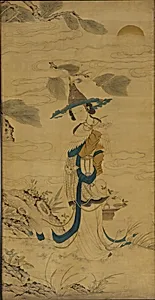
Female immortal with a basket
1575-1725
Classification
Costume and Textile
Department
Smithsonian Collection
Museum
Smithsonian American Art Museum
Credit
Gift of Charles Lang Freer
Accession Number
F1911.269
Rights
Public Domain
Tags
About this artwork
To 1911
Art Historical Context
This exquisite silk tapestry, titled *Female Immortal with a Basket dates to 1575–1725, spanning the late Ming (1368–1644) and early Qing (164–1911) dyn in China. Depicting a graceful female Daoist immortal—likely one of the revered *xian* figures from Chinese mythology—she carries a basket amid symbolic motifs like the fungus of immortality (*lingzhi*), pine tree, orchid, and radiant sun. Woven with masterful precision, this textile exemplifies *kesi*, a fine silk tapestry technique prized for its painterly detail and vibrant colors, often used for decorative hangings in scholarly or elite homes. In Daoist tradition, such immortals embody spiritual transcendence and eternal life, with the pine signifying longevity, the orchid nobility and refinement, and *lingzhi* the ultimate elixir of immortality. Created during a golden age of Chinese textile arts, the work reflects the Ming-Qing fusion of artistic innovation and philosophical depth, blending realism with auspicious symbolism to inspire contemplation. A cherished piece from the Charles Lang Freer collection, gifted to the Smithsonian American Art Museum, it highlights Freer's passion for Chinese art and offers visitors a window into imperial-era devotion to Daoism and nature's enduring harmony.
About the Artist
Unknown
The artist designated as "Unknown" in our virtual museum's collection exemplifies a poignant chapter in art history: creators whose identities have faded into obscurity despite the enduring power of their work. With only one known artwork attributed to them in our holdings, this figure represents countless anonymous hands that shaped visual culture across centuries. Museums worldwide, including th...