
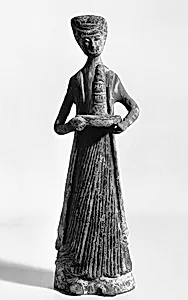
隋 陶女楽伎俑|Female musician
Unknown Artist
6th century
Medium
Earthenware with traces of pigment
Dimensions
H. 9 in. (22.9 cm)
Classification
Tomb Pottery
Culture & Period
China · Sui dynasty (581–618)
Department
Asian Art
Museum
Metropolitan Museum of Art, New York, NY
Credit
Gift of Mrs. Edward S. Harkness, 1934
Accession Number
34.141.2
Rights
Public Domain
Tags
Art Historical Context
This charming earthenware figurine, titled *Female Musician* (隋 陶女楽伎俑), hails from China's Sui dynasty (581–), a pivotal era that reunified the fractured empire after centuries of division and paved the way for the golden age of the Tang. just 9 inches (22.9 cm) tall, this unknown artist's creation captures a graceful female entertainer, likely holding trays associated with musical performance—a nod to the lively courtly culture of the time. Crafted from low-fired clay with faint traces of original pigments, it exemplifies *mingqi* tomb pottery, ritual objects buried with the elite to provide companionship and entertainment in the afterlife. Sui tomb figures like this one mark a stylistic evolution, blending Northern Wei realism with Southern grace, resulting in expressive poses and detailed attire that reflect everyday life. The subtle pigmentation hints at once-vibrant colors that animated these spirits during funerary rites, underscoring beliefs in an eternal, harmonious underworld. Donated to the Metropolitan Museum of Art in 1934 by Mrs. Edward S. Harkness, this piece offers visitors a tangible glimpse into 6th-century Chinese society, where music and women performers symbolized prosperity and joy beyond the grave.