
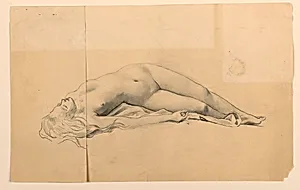
Female Nude
Classification
figures
Department
Smithsonian Collection
Museum
Smithsonian American Art Museum
Credit
Gift of Mrs. J. Wells Champney
Accession Number
1904-7-13-b
Rights
Public Domain
About this artwork
Research in Progress
Art Historical Context
James Wells Champney (184–1903), a prominent American artist and illustrator, created *Female Nude* around 1890, a period when he was blending European academic influences with emerging American realism. Born in Massachusetts, Champney studied in Paris at the École des Beauxts, honing skills in figure drawing that defined much of his oeuvre. His works often celebrated feminine grace through illustrations for Harper's Weekly and murals like those in New York’s Bowery Savings Bank, this intimate nude a likely testament to his rigorous training in classical anatomy. As a study in the figure genre, the painting reflects the late 19th-century artistic tradition of the female nude, symbolizing beauty, vulnerability, and the human form's idealization. In Victorian-era America, such works were typically confined to private or academic spaces, underscoring Champney's sophisticated, cosmopolitan style amid a conservative cultural landscape. Though the medium remains unidentified amid ongoing research, its presence in the Smithsonian American Art Museum highlights Champney's role in elevating American illustration to fine art. This piece, gifted by Mrs. J. Wells Champney—likely the artist's widow—offers a glimpse into personal artistic practice. Visitors can appreciate how Champney's elegant line and subtle modeling bridged old-world mastery with New World's vitality.