
Ferret
Unknown Artist
6th–7th centuries
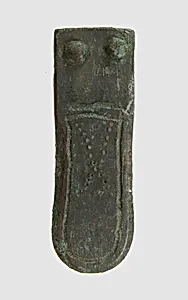
Medium
Copper alloy
Dimensions
Overall: 2 x 5/8 x 1/4 in. (5.1 x 1.6 x 0.6 cm)
Classification
Metalwork-Copper alloy
Culture
Frankish
Department
Medieval Art
Museum
Metropolitan Museum of Art, New York, NY
Credit
Gift of J. Pierpont Morgan, 1917
Accession Number
17.193.248
Rights
Public Domain
Art Historical Context
This diminutive copper alloy figurine, titled *Ferret*, hails from the Frankish culture of the 6th–7th centuries, a pivotal era in early medieval Europe during the Merovingian dynasty.ed by an unknown artist, its tiny scale—measuring just 2 x 5/8 x 1/4 inches—lights the extraordinary finesse of Frankish metalworkers. Likely a decorative mount or amulet, the piece captures the alert form of a ferret, a creature associated with hunting and agility in the daily lives of the Franks. Frankish metalwork like this exemplifies the transition from late Roman traditions to distinctly early medieval artistry. Copper alloy, valued for its durability and workability, was cast or hammered into intricate forms, often adorned with subtle chasing or engraving techniques. Such small-scale sculptures were prized possessions, possibly adorning belts, harnesses, or personal items, reflecting the Franks' blend of Germanic craftsmanship and Christianizing influences. A generous gift to the Metropolitan Museum of Art from J. Pierpont Morgan in 1917, *Ferret* invites us to marvel at the unsung artistry of the early Middle Ages. Its survival offers a glimpse into a world where everyday animals symbolized vitality and skill, bridging the ancient and medieval realms.