
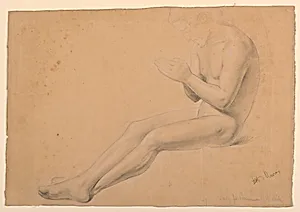
Figure Study for "Communion of the Sick"
Classification
figures
Department
Smithsonian Collection
Museum
Smithsonian American Art Museum
Credit
Bequest of Erskine Hewitt
Accession Number
1942-50-118
Rights
Public Domain
About this artwork
Research in Progress
Art Historical Context
Daniel Huntington's *Figure Study for "Commun of the Sick"* (4–45) offers a glimpse into the meticulous preparatory process of one of America's foremost 19th-century painters. Born in 1816, Huntington was a key figure in the New York art scene, serving as president of the National Academy of Design and blending neoclassical precision with emerging American realism. Created early in his career, shortly after his studies in Europe, this work supported his larger painting depicting the Catholic rite of Viaticum—administering communion to the ill—reflecting the era's interest in moral and religious themes amid America's growing cultural sophistication. As a figure study, it highlights Huntington's academic training, emphasizing anatomy, pose, and expression to capture human vulnerability and spirituality. Such sketches were essential in the 1840s studio practice, bridging European traditions with American subjects and allowing artists to refine compositions before committing to oil on canvas. Though the medium remains unidentified amid ongoing research, its classification as a "figures" piece underscores its focus on the body's emotional resonance. Housed in the Smithsonian American Art Museum through the bequest of collector Erskine Hewitt, this study invites visitors to appreciate the hidden labor behind grand narratives, connecting us to Huntington's enduring legacy in shaping American art.