
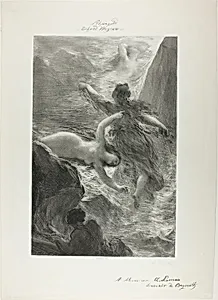
First Scene of The Rhinegold
Medium
Lithograph in black with scraping on stone on grayish-ivory china paper laid down on thick cream wove paper
Dimensions
Image: 51.2 × 33.5 cm (20 3/16 × 13 1/4 in.); Primary support: 51.2 × 33.5 cm (20 3/16 × 13 1/4 in.); Secondary support: 69.7 × 49.8 cm (27 1/2 × 19 5/8 in.)
Classification
lithograph
Department
Prints and Drawings
Museum
Art Institute of Chicago
Accession Number
44013
Rights
Public Domain
About this artwork
The Rhinegold is the first of four operas that form Richard Wagner's operatic cycle Ring of the Nibelung. In this interpretation of the opera's first scene, three Rhine maidens gracefully dive through the water's currents as they protect their treasure, the gold of the River Rhine. The figure of Alberich, who greedily schemes to steal the Rhine gold, appears ominously in the lower-left corner of the composition.
Art Historical Context
Henri Fantin-Latour's *First Scene of The Rhine* (1876) captures a pivotal moment from Richard Wagner's groundbreaking opera cycle *Der Ring des Nibel*. The French artist, renowned for his realistic portraits and intimate still lifes, turned his talents to Wagnerian mythology in this lithograph, depicting the mystical depths of the Rhine River where the Rhinegold lies guarded by nymphs. Created amid the excitement of Wagner's first Bayreuth Festival that year, it reflects Fantin-Latour's deep admiration for the composer's epic vision, blending 19th-century Romanticism with precise draftsmanship. This work exemplifies lithography's versatility as a reproductive medium, allowing artists to achieve painterly effects through greasy crayon on limestone. Fantin-Latour's innovative use of scraping on the stone created subtle textures and highlights, enhancing the ethereal underwater scene. Printed in black ink on delicate grayish-ivory china paper and laid down on sturdy cream wove support (image: 51.2 × 33.5 cm), it showcases the technique's ability to convey drama and depth affordably, making Wagner's world accessible to a wider audience. Housed in the Art Institute of Chicago's Prints and Drawings Department, this lithograph highlights the cultural fusion of French visual art and German music drama, bridging opera and fine printmaking during a transformative era in European arts.
About the Artist
Henri Fantin-Latour · 1836–1904
Ignace Henri Jean Théodore Fantin-Latour was born on January 14, 1836, in Grenoble, France, to portrait painter Théodore Fantin-Latour, who gave him his earliest drawing lessons. The family relocated to Paris in 1841, where in 1850, at age 14, he enrolled in the École de Dessin, studying under Horace Lecoq de Boisbaudran, whose innovative memory-based method of drawing from observation profoundly ...