
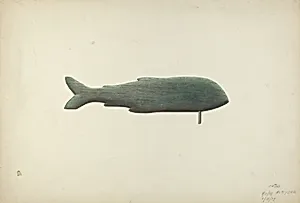
Fish Weather Vane
1939
Medium
watercolor and graphite on paperboard
Dimensions
overall: 38.1 x 45.7 cm (15 x 18 in.) Original IAD Object: 30" wide
Classification
Index of American Design
Department
CG-W
Museum
National Gallery of Art, Washington, D.C.
Credit
Index of American Design
Accession Number
1943.8.16315
Rights
Public Domain
Art Historical Context
Behold the *Fish Weather Vane*, captivating 1939 watercolor and graphite rendering on paperboard by artist Albert Ryder, measuring 15 x 18 inches. This piece, housed in the National Gallery of, meticulously captures the whimsical form of a traditional American folk art weather vanelikely an original object around 30 inches wide—icting a sleek fish in mid-leap, its scales and fins rendered with fluid precision. Ryder's delicate use of watercolor evokes the patina of weathered metal, while graphite outlines add sharp definition, bringing the utilitarian object to life as a work of art. Created as part of the Index of American Design (IAD), a groundbreaking WPA Federal Art Project from the 1930s and 1940s, this drawing preserves the ingenuity of everyday American craftsmanship. The IAD commissioned artists to document folk art, tools, and designs, safeguarding cultural heritage during the Great Depression. Weather vanes like this fish motif, often found on barns or ships, symbolized regional pride—perhaps evoking New England's seafaring traditions—and highlighted the anonymous makers' blend of functionality and fantasy. Ryder's technique exemplifies the IAD's emphasis on accurate, colorful reproductions, bridging historical artifact and modern appreciation. For visitors, it offers a window into America's vernacular design, where humble objects whisper stories of wind, weather, and the human spirit.
About the Artist
Albert Ryder · 1911–2001
Albert Ryder is an artist for whom biographical documentation is limited. No birth or death dates have been confirmed in major reference sources, and his nationality and training are not established in available records. His name is likely distinct from that of Albert Pinkham Ryder (1847–1917), the celebrated American symbolist painter, and should not be conflated with that better-documented figu...