
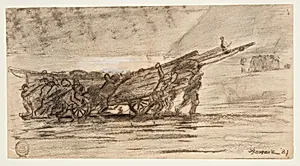
Fishermen Beaching a Boat, Cullercoats, England
Classification
seascapes
Department
Smithsonian Collection
Museum
Smithsonian American Art Museum
Credit
Gift of Charles Savage Homer, Jr.
Accession Number
1912-12-40
Rights
Public Domain
About this artwork
Research in Progress
Art Historical Context
In 1881, American artist Winslow Homer captured the drama of coastal life in *Fishermen Be a Boat, Cullerats, England*, a quintessential seascape from his brief but transformative stay in England's North Sea fishing village of Cullercoats (near Tynemouth). age 45, Homer immersed himself in local community, living with a fisherman's family and sketching the perilous daily labors of hauling boats ashore amid crashing waves. This work reflects his fascination with the sea's unforgiving power and the resilience of working people, themes that defined his later career. Homer, a pioneer of American Realism, moved beyond romanticized landscapes to portray raw, unvarnished truth—often through dynamic compositions that pit human figures against nature's fury. Though the medium is undocumented, his Cullercoats series famously advanced his watercolor mastery, blending loose, fluid strokes with precise detail to evoke motion and atmosphere. Donated by his nephew Charles Savage Homer, Jr., to the Smithsonian American Art Museum, this piece exemplifies Homer's shift toward international influences while cementing his legacy as America's preeminent marine painter. Today, it invites visitors to ponder the timeless struggle between man and sea, a vivid window into 19th-century maritime culture.