
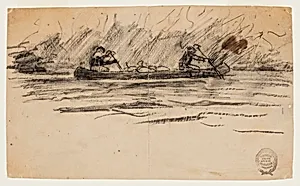
Canoe with Two Men
Classification
landscapes
Department
Smithsonian Collection
Museum
Smithsonian American Art Museum
Credit
Gift of Charles Savage Homer, Jr.
Accession Number
1912-12-45
Rights
Public Domain
About this artwork
Research in Progress
Art Historical Context
**Canoe with Men** (1895) by Winslow Homer captures the rugged beauty of the American wilderness, a hallmark of the artist's late-career focus on nature's quiet drama. Born in 1836, Homer rose to prominence as a Realist painter, evolving from War illustrations to masterful depictions of coastal and inland scenes. By 1895, at age 59, he had retreated to his Prouts Neck, Maine studio where works like this landscape reflect his deep affinity for water and solitude—two figures gliding in a canoe evoke the era's growing fascination with outdoor adventure and escape from industrialization. Classified as a landscape, this piece exemplifies Homer's signature Realism, emphasizing raw environmental forces through precise observation. Though the medium remains unidentified amid ongoing research, Homer's prowess in watercolor and oil often rendered light dancing on waves and the tension between man and nature, influencing American art's shift toward truthful, unromanticized portrayals of everyday heroism. A cherished gift to the Smithsonian American Art Museum from Charles Savage Homer, Jr.—likely a family member—this work invites visitors to ponder the timeless pull of untamed waters, bridging 19th-century exploration with our own quests for serenity. (198 words)