
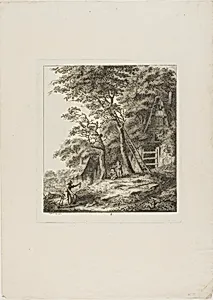
Fishermen with Children, plate two from Paysages Dédiés à M. Warelet
1764
Medium
Etching on cream laid paper
Dimensions
Plate: 21.2 × 18.9 cm (8 3/8 × 7 1/2 in.); Sheet: 38.9 × 27.6 cm (15 3/8 × 10 7/8 in.)
Classification
etching
Department
Prints and Drawings
Museum
Art Institute of Chicago
Accession Number
129438
Rights
Public Domain
Art Historical Context
Salomon Gessner *Fishermen with Children*, plate two from the series *aysages Dédiés à M. Warelet* (1764), captures the serene beauty of everyday rural life in an etching on cream laid paper. This intimate print, measuring 21.2 × 18.9 cm on a larger sheet, depicts fishermen and playful children amid a lush landscape, evoking Gessner’s signature idyllic pastoral scenes. Dedicated to the patron M. Warelet, the reflects the Swiss artist-poet’s fascination with harmonious nature, blending poetry and visual art in the Rococo tradition. Gessner (1730–1788), a celebrated figure in 18th-century Europe, drew inspiration from classical idylls and the Enlightenment’s reverence for simplicity and the natural world. His works, often romanticizing peasants and waterways, influenced early Romanticism and were widely reproduced through prints like this one. Produced during a time when etching allowed artists to reach broader audiences beyond oil paintings, this piece exemplifies Gessner’s delicate linework—fine, fluid strokes that convey movement in water and tender familial bonds. Housed in the Art Institute of Chicago’s Prints and Drawings department, this etching invites visitors to appreciate how Gessner’s gentle, sentimental style bridged literature and art, offering a nostalgic escape into an idealized countryside. A testament to printmaking’s accessibility, it remains a charming highlight of 18th-century landscape tradition.
About the Artist
Salomon Gessner · 1730–1788
Salomon Gessner was born in Zurich in 1730 into a family of printers and publishers, an upbringing that placed books, images, and ideas at the center of his world from an early age. Though largely self-taught as a visual artist, he received some instruction during a period in Berlin, where he encountered the German Rococo tradition, and his mature work reflects a deep absorption in the pastoral li...