
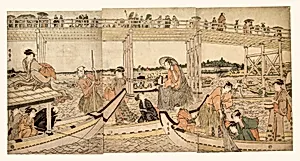
Fishing Boats with Nets under Ryōgoku Bridge
1790s
Medium
Triptych of woodblock prints; ink and color on paper
Dimensions
a: H. 14 7/8 in. (37.8 cm); W. 9 7/8 in. (25.1 cm) b: H. 15 in. (38.1 cm); W. 9 3/4 in. (24.8 cm) c: H. 14 5/16 in. (36.4 cm); W. 9 15/16 in. (25.2 cm)
Classification
Prints
Culture & Period
Japan · Edo period (1615–1868)
Department
Asian Art
Museum
Metropolitan Museum of Art, New York, NY
Credit
H. O. Havemeyer Collection, Bequest of Mrs. H. O. Havemeyer, 1929
Accession Number
JP1687
Rights
Public Domain
Tags
Art Historical Context
Created in the 1790s during Japan’s Edo period, *Fishing Boats with Nets under Ryōg Bridge* is a striking tript by the celebrated ukiyo-e master Kitagawa Utamaro. Printed in ink and color on paper, the three sheets together capture a lively riverside scene on the Sumida River beneath the famous Ryōgoku Bridge in Edo (modern-day Tokyo). Utamaro, renowned for his sensitive portrayals of women and everyday urban life, here expands his gaze to include fishermen, boats, and the bustling activity along the water. Woodblock prints like this one were a hallmark of Edo-period visual culture, making art affordable and widely accessible to merchants and townspeople. The triptych format allowed artists to create panoramic compositions that feel immersive, inviting viewers to imagine standing on the bridge itself. The delicate layering of colors and crisp lines demonstrate the technical sophistication of Japanese printmaking at its peak. Today housed in the Metropolitan Museum of Art as part of the H. O. Havemeyer Collection, the work offers a vivid glimpse into the rhythms of Edo life—where commerce, leisure, and labor met along the city’s waterways.
About the Artist
Kitagawa Utamaro · 1753–1806
Kitagawa Utamaro (c. 1753-1806) was one of the most celebrated masters of ukiyo-e woodblock printing, revolutionizing the art of bijin-ga (pictures of beautiful women) during Japan's Edo period. Born Kitagawa Ichitaro, his early life remains shrouded in mystery, with conflicting accounts placing his birth in Kyoto, Osaka, Yoshiwara in Edo (modern Tokyo), or Kawagoe in Musashi Province. Under the t...