
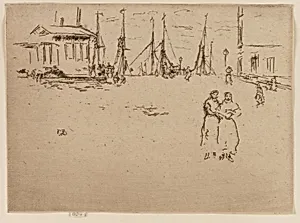
Fishing Quay, Ostend
Classification
Department
Smithsonian Collection
Museum
Smithsonian American Art Museum
Credit
Gift of Charles Lang Freer
Accession Number
F1896.48
Rights
Public Domain
Tags
About this artwork
Whistler etchings are identified by "G" numbers as assigned in "James McNeill Whistler: The Etchings, a catalogue raisonne," by Margaret F. McDonald, Grischka Petri, Meg Hausberg, and Joanna Meacock (University of Glasgow, 2012), http://etchings.arts.gla.ac.uk. This print is G351 state 1 of 1.
Art Historical Context
**Fishing Quay, Ost** (1887) by JamesNeill Whistler captures the bustling harbor of Ostend, a vibrant Belgian city popular among 19th-century artists and. Whistler, an American-born and printmaker who spent much of his career in, created this etching during a period prolific printmaking. Known for his Aestheticist philosophy—"art for art's sake"—and subtle, atmospheric compositions, he often depicted everyday scenes with a poetic, impressionistic touch, evoking mood over detail. As an etching (G351, state 1 of 1), this print exemplifies Whistler's mastery of the medium, where acid etches intricate lines into a metal plate for tonal subtlety and depth. His etchings, cataloged meticulously by scholars at the University of Glasgow, blend realism with abstraction, influencing modern printmakers. Produced in the late 1880s, it reflects Whistler's fascination with light, water, and labor, themes echoing his famous Thames series. A highlight of the Smithsonian American Art Museum's collection, this work was generously gifted by industrialist Charles Lang Freer, Whistler's devoted patron and friend. Freer's donation formed the core of the museum's Asian and American art holdings, making *Fishing Quay, Ostend* a bridge between Whistler's transatlantic legacy and enduring cultural appreciation for his innovative prints.