
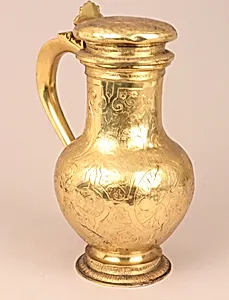
Flagon
19th century, after 1596–97 original
Medium
Silver on base metal
Dimensions
Height: 10 in. (25.4 cm)
Classification
Metalwork-Electrotype
Culture
British, Birmingham, after British, London original
Department
European Sculpture and Decorative Arts
Museum
Metropolitan Museum of Art, New York, NY
Credit
Gift of Henry G. Marquand, 1883
Accession Number
83.18.13
Rights
Public Domain
Art Historical Context
This elegant flagon, crafted by the renowned British firm Elkington & Co. in 19th-century Birmingham, is a faithful electrotype reproduction of a late Elizabethan original from London dated 1596–97. Standing at 10 inches, it exemplifies the opulent metalwork of Renaissance England, where flagons served as ceremonial vessels for wine or ale during banquets and religious rites. The original's intricate chasing and embossing—hallmarks of skilled silversmithing—evoke the grandeur of Tudor courts, blending functional design with symbolic ornamentation. Elkington & Co. revolutionized decorative arts through electrotyping, a pioneering Victorian electroplating technique that deposited a thin layer of silver over base metal. This innovation allowed museums and collectors to acquire precise, affordable copies of priceless artifacts without damaging originals, democratizing access to history. Classified as metalwork in The Metropolitan Museum of Art's European Sculpture and Decorative Arts, this piece was generously gifted by Henry G. Marquand in 1883, highlighting the era's passion for historical revival. Today, it invites visitors to appreciate how 19th-century ingenuity preserved Elizabethan craftsmanship, bridging centuries of British cultural heritage in shimmering silver detail.
About the Artist
Elkington & Co. · 1829–1963
Elkington & Co. was the Birmingham firm that transformed the production of decorative metalwork by commercializing electroplating — a process that made silver-quality objects accessible to a vastly wider public. The company was established by George Richards Elkington (1801–1865) and his cousin Henry Elkington during the 1830s, initially trading as G. R. Elkington & Co. A crucial turning point cam...