
Flat Ornament
Unknown Artist
7th century (?)
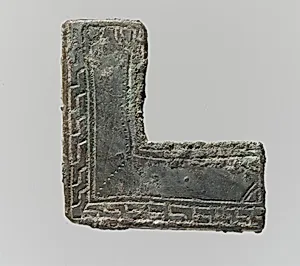
Medium
Copper alloy, "tinned" surface
Dimensions
Overall: 1 7/16 x 1 3/8 x 3/8 in. (3.6 x 3.5 x 0.9 cm)
Classification
Metalwork-Copper alloy
Culture
Frankish
Department
Medieval Art
Museum
Metropolitan Museum of Art, New York, NY
Credit
Gift of J. Pierpont Morgan, 1917
Accession Number
17.191.231
Rights
Public Domain
Art Historical Context
This delicate *Flat Ornament*, by an unknown Frankish artist around the 7th century, offers a glimpse into the refined metalworking traditions of early medieval Europe. Measuring just 1 7/16 x 1 3/8 x 3/8 inches, this small copper alloy piece features a tinned surface—a technique where a thin layer of tin was applied to create a bright, silvery sheen, mimicking more precious silver while making it accessible for everyday adornment. Likely used as a brooch, buckle, or clothing mount, its flat form highlights the Franks' skill in producing functional yet elegant personal ornaments during the Merovingian period. The Franks, a Germanic people who dominated what is now France and Germany after the fall of Rome, were renowned for their intricate metalwork. This artifact, housed in the Metropolitan Museum of Art's Medieval Art Department (gift of J. Pierpont Morgan, 1917), exemplifies their cultural fusion of Roman influences and barbarian artistry. The tinning process not only enhanced durability and aesthetics but also reflected resourcefulness in an era of scarce luxury metals. Though its exact design remains understated in surviving records, the ornament's survival speaks to the enduring quality of Frankish craftsmanship, bridging the gap between late antiquity and the Carolingian Renaissance. A testament to anonymous artisans' ingenuity!