
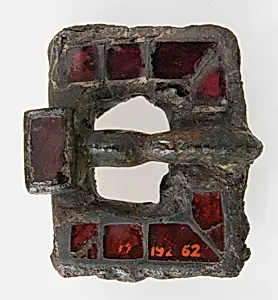
Flat Rectangular Buckle
Unknown Artist
end of the 5th–early 6th century
Medium
Copper alloy, gilt (tongue); 1/2 silver-gilt iron with garnets (plaque)
Dimensions
Overall: 1 3/8 x 1 1/4 x 9/16 in. (3.5 x 3.1 x 1.4 cm)
Classification
Metalwork-Copper
Culture
Frankish
Department
Medieval Art
Museum
Metropolitan Museum of Art, New York, NY
Credit
Gift of J. Pierpont Morgan, 1917
Accession Number
17.192.62
Rights
Public Domain
Art Historical Context
This exquisite Flat Rectangular Buckle, crafted by an unknown Frankish artisan at the end of the th to early 6th century exemplifies the masterful metalwork of the early Medieval period. Hailing from the Frankish culture—associated with the rising Merovingian kingdoms in post-Roman Gaul—this small yet striking accessory (measuring just 1 3/8 x 1 1/4 x 9/16 inches) would have adorned a belt, signaling the wearer's status amid the turbulent Migration Period. The buckle's construction highlights sophisticated techniques: a copper alloy tongue coated in gilt for a golden sheen, paired with a plaque of half silver-gilt iron inlaid with garnets. Garnets, prized for their deep red hue, were a hallmark of elite Germanic and Frankish jewelry, often set in intricate cellwork to catch the light. This blend of base and precious metals reflects both accessibility and luxury, showcasing the era's advanced gilding and inlay skills that bridged late Roman traditions with emerging barbarian artistry. A generous gift to the Metropolitan Museum of Art from J. Pierpont Morgan in 1917, this buckle offers a tangible glimpse into daily life and cultural transitions during Europe's early Middle Ages, where such functional objects doubled as symbols of power and piety.