
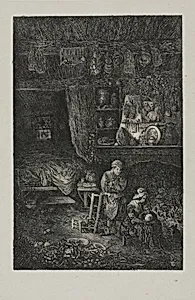
Flemish Interior
1856
Medium
Lithograph (etching transfer) on light gray China paper laid down on off-white wove paper
Dimensions
Image: 15.9 × 10.5 cm (6 5/16 × 4 3/16 in.); Chine: 18.9 × 12.4 cm (7 1/2 × 4 15/16 in.); Sheet: 32.7 × 25.1 cm (12 7/8 × 9 15/16 in.)
Classification
lithograph
Department
Prints and Drawings
Museum
Art Institute of Chicago
Accession Number
27803
Rights
Public Domain
Art Historical Context
Rodolphe Bresdin’s *Flemish Interior*1856) offers a captivating glimpse into a meticulously rendered domestic scene, evoking the quiet intimacy of seventeenth-century Flemish painting traditions. Created during a period when printmaking was flourishing as both an artistic and accessible medium, work reflects the nineteenth-century fascination with styles reinterpreted through modern techniques. Bresdin, working in France, employed an etching-transfer process to achieve the fine detail and tonal richness typically associated with more labor-intensive methods. The lithograph’s delicate execution on light gray China paper laid onto a larger sheet highlights the artist’s command of texture and light, inviting viewers to explore the subtle play of shadows within the interior. Such prints were prized for their ability to circulate widely while retaining the intimacy of a drawing, making art more available to a growing middle-class audience. Today, this piece in the Art Institute of Chicago’s collection exemplifies how nineteenth-century printmakers bridged old-master subjects with innovative reproduction processes, preserving a sense of timeless domestic harmony.
About the Artist
Rodolphe Bresdin · 1822–1885
Rodolphe Bresdin (1822–1885) was a visionary French draughtsman, engraver, and lithographer whose fantastical imagery captured the empathy of rural poverty and the wild exuberance of the imagination. Born on August 12, 1822, in Montrelais near Le Fresne-sur-Loire in Brittany, he grew up in the Breton countryside amid its bardic folklore traditions before a family dispute left him homeless in Paris...