
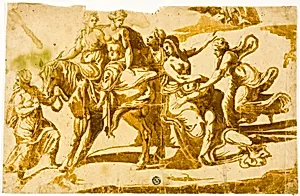
Flight of Celia
Medium
Black chalk and brush and brown wash on tan laid paper
Dimensions
22.2 × 34.2 cm (8 3/4 × 13 1/2 in.)
Classification
chalk and wash
Department
Prints and Drawings
Museum
Art Institute of Chicago
Accession Number
4063
Rights
Public Domain
Art Historical Context
Behold the dynamic drawing *Flight of Celia* by Polidoro da Caravaggio a masterful 16th-century Italian artist renowned for his dramatic compositions and ties to the High Renaissance. Active in Rome during the 1520s, Polidoro collaborated on grand projects like the frescoes at the Farnesina before the 1527 Sack of Rome disrupted his career, leading him to create poignant drawings like this one. Though undated, it exemplifies his shift toward expressive, narrative sketches that capture movement and emotion amid turbulent times. Executed in black chalk and brush with brown wash on tan laid paper, this intimate sheet (22.2 × 34.2 cm) showcases Polidoro's virtuoso technique. The chalk provides precise modeling and contour, while the fluid wash adds depth and atmospheric drama, evoking the chiaroscuro effects that influenced later artists like the Caravaggisti. Housed in the Art Institute of Chicago's Prints and Drawings Department, it highlights the Renaissance tradition of preparatory studies—versatile tools for painters that reveal an artist's raw creative process. The title suggests a scene of swift escape, perhaps drawing from classical or literary sources, rendered with Polidoro's characteristic energy. For visitors, this work offers a window into the ingenuity of Renaissance draftsmen, blending technical prowess with storytelling flair.
About the Artist
Polidoro da Caravaggio · 1492–present
Polidoro Caldara, known as Polidoro da Caravaggio, was born around 1499 in Caravaggio, Lombardy, and emerged as one of the most innovative painters of the early Mannerist period. Arriving in Rome circa 1515 as an untrained laborer hauling plaster for the Vatican Logge decorations, he quickly caught the eye of Raphael's key assistant, Maturino da Firenze. By 1517, Polidoro had joined Raphael's work...