
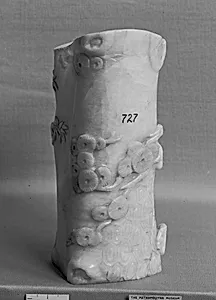
Flower vase
Unknown Artist
1796–1875
Medium
Jadeite, lavender veined with green of varied tone passing from pale green through lettuce green to bright emerald, with occasional touches of light brown
Dimensions
H. 5 7/8 in. (15 cm); W. 2 3/4 in. (7 cm); D. 2 1/2 in. (6.4 cm)
Classification
Jade
Culture & Period
China · Qing dynasty (1644–1911)
Department
Asian Art
Museum
Metropolitan Museum of Art, New York, NY
Credit
Gift of Heber R. Bishop, 1902
Accession Number
02.18.727
Rights
Public Domain
Art Historical Context
This exquisite flower vase, crafted from rare jadeite during China's Qing dynasty (16441911), dates to 1796 and 1875. Standing just under 6 inches tall, its compact form—5 7/8 in. high, 2 3/4 in. wide, and 2 1/2 in. deep—belies the masterful artistry of an unknown carver. The stone's lavender hue is veined with greens ranging from pale to lettuce and vibrant emerald tones, accented by subtle light brown touches, creating a natural mosaic that highlights the material's organic beauty. Jadeite, prized in imperial China for its translucency and durability, held profound cultural significance as a symbol of purity, virtue, and immortality. Qing artisans, often working in palace workshops, perfected techniques to reveal the stone's veining through precise carving, transforming raw boulders into elegant vessels like this one. Flower vases were favored by scholars and elites for displaying fresh blooms, blending nature's ephemerality with jade's enduring grace. A gift to the Metropolitan Museum of Art from Heber R. Bishop in 1902, this piece exemplifies the dynasty's jade legacy, inviting us to appreciate the harmony of color, form, and tradition in Asian art.