
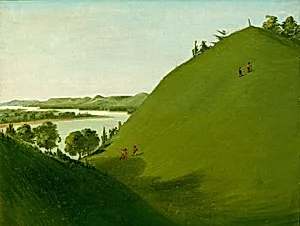
Floyd's Grave, Where Lewis and Clark Buried Sergeant Floyd in 1804
1832
Medium
Painting
Classification
Painting
Department
Smithsonian Collection
Museum
Smithsonian American Art Museum
Credit
Smithsonian American Art Museum, Gift of Mrs. Joseph Harrison, Jr.
Accession Number
1985.66.376
Rights
Public Domain
Tags
About this artwork
George Catlin’s view of a bluff some twelve hundred miles above St. Louis captures the vast scale of a continent that, in the 1830s, was only beginning to be settled by white Americans. The artist swept bright green paint across the foreground to suggest the brilliant glow of spring, and spotted the hillside with tiny figures that lead the eye upward. The thinly painted line at the top of the bluff is the cedar post marking the grave of Sergeant Floyd, a member of the Lewis and Clark expedition....
Art Historical Context
In 1832, George Catlin, the pioneering American artist renowned for his vivid depictions of the untamed West and Native American, painted *Floyd's Grave, Lewis and Clark Buried Floyd in 1804*. This oil painting commemorates the burial site of Sergeant Charles Floyd the only member of the Lewis and Expedition to die during their epic 1804 journey up the Missouri River. Located on a bluff some 1,200 miles above St Louis, the spot marked a poignant moment in early American exploration, as Floyd succumbed to illness and was interred under a cedar post—still faintly visible as a thin line atop the hill in Catlin's canvas. Catlin's Romantic style captures the continent's vast, pristine scale, with brilliant green paint evoking spring's glow in the foreground and tiny figures dotting the hillside to guide the viewer's eye upward. He visited the remote site multiple times by canoe, climbing the mound to reflect on its "solitude and stillness," the winding Missouri, and its green hills fading into blue distance—a place where he felt closest to God. This work, now in the Smithsonian American Art Museum, underscores the frontier's allure and fragility as white settlement loomed.
About the Artist
George Catlin · 1796–1872
George Catlin (1796–1872), born in Wilkes-Barre, Pennsylvania, to Putnam Catlin and Polly Sutton—who had been captured by Native Americans during the 1778 Battle of Wyoming—initially pursued a legal career. Trained at Litchfield Law School, he was admitted to the bar in 1819 but abandoned law after two years to study art in Philadelphia in 1823. Self-taught as a portraitist, Catlin quickly gained ...