
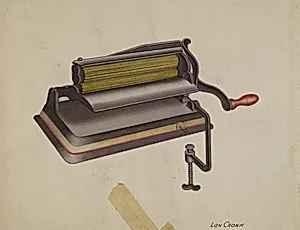
Fluting Iron
c. 1941
Medium
watercolor, graphite, and pen and ink on paper
Dimensions
overall: 21.6 x 28.2 cm (8 1/2 x 11 1/8 in.)
Classification
Index of American Design
Department
CG-W
Museum
National Gallery of Art, Washington, D.C.
Credit
Index of American Design
Accession Number
1943.8.11629
Rights
Public Domain
Art Historical Context
**Fluting Iron** by Lon Cronk (c. 1941) captures the humble elegance of a traditional American household tool—a fluting iron, used in the 19th and early 20th centuries to crimp and pleat fabrics for ruffles, collars, and linens. Rendered in watercolor, graphite, pen and ink on paper (21.6 x 28.2 cm), this drawing belongs to the *Index of American Design*, landmark WPA Federal Art Project from the Great Depression era (1935–1942). Commissioned to celebrate everyday American craftsmanship, the Index employed artists like Cronk to document folk objects, preserving cultural heritage amid economic hardship. Cronk's meticulous technique blends graphite and pen for sharp outlines, graphite for subtle shading, and watercolor for vibrant, realistic hues that evoke the iron's polished metal and wooden handle. This mixed-media approach ensured scientific accuracy while highlighting aesthetic beauty, making the ordinary extraordinary. Housed in the National Gallery of Art's CG-W department, it reflects Depression-era pride in vernacular design—tools born of ingenuity that shaped domestic life. Today, *Fluting Iron* reminds us of women's labor in pre-industrial homes and the WPA's role in fostering national identity through art. A testament to functional beauty, it invites reflection on how simple objects encode history.
About the Artist
Lon Cronk · 1855–present
Lon Cronk remains one of the more elusive figures in the broader history of art, with biographical records offering little concrete detail about his life, training, or national background. The limited documentation surrounding his career makes it difficult to situate him within a specific movement or tradition, though works attributed to him suggest a practitioner of some technical competence. Wh...