
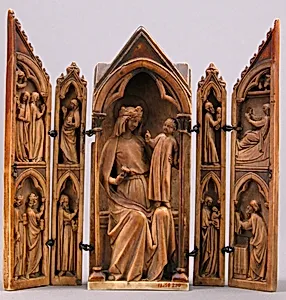
Folding Shrine with Virgin and Child
Unknown Artist
ca. 1325
Medium
Elephant ivory with metal mounts
Dimensions
Overall (open): 5 1/2 x 5 3/4 x 13/16 in. (13.9 x 14.6 x 2.1 cm) Overall (closed): 5 1/2 x 2 5/8 x 1 in. (13.9 x 6.7 x 2.6 cm) central plaque: 5 5/16 x 2 x 13/16 in. (13.5 x 5.1 x 2.1 cm) Inner Wings L & R: 4 5/8 x 11/16 x 1/4 in. (11.7 x 1.7 x 0.7 cm) Outer Wings L & R: 5 1/2 x 1 x 1/4 in. (13.9 x 2.5 x 0.6 cm)
Classification
Ivories-Elephant
Culture
French
Department
Medieval Art
Museum
Metropolitan Museum of Art, New York, NY
Credit
Gift of J. Pierpont Morgan, 1917
Accession Number
17.190.290
Rights
Public Domain
Tags
Art Historical Context
This exquisite *Folding Shrine with Virgin and Child*, crafted 1325 by an unknown French artist, exemplifies refined artistry of medieval Gothic ivory carving. Fashioned from elephant ivory with metal mounts, it served as a portable devotional object, likely carried by pilgrims or used in private prayer. When opened, the shrine measures about 5½ x 5¾ inches, revealing a central plaque with the tender image of the Virgin Mary holding Christ Child, flanked by inner and outer wings that unfold like a triptych altarpiece. Ivory, prized for its creamy translucence and durability, was a luxury material in 14th-century France, symbolizing purity and evoking the era's deep Marian devotion. The intricate carving techniques—delicate undercutting for flowing drapery and expressive faces—highlight the sculptor's mastery, allowing light to play across the surfaces and bring the holy figures to life. Its compact closed form (5½ x 2⅝ x 1 inches) made it ideal for personal piety amid the Gothic emphasis on emotional spirituality. A gift to the Metropolitan Museum of Art from J. Pierpont Morgan in 1917, this rare survivor from the Medieval Art collection invites us to ponder the intimate faith of medieval Europeans, folding sacred art into everyday devotion.