
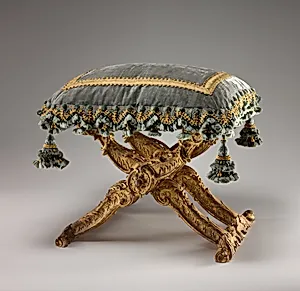
Folding stool (pliant) (one of a pair)
Unknown Artist
ca. 1735–39
Medium
Carved and gilded walnut; silk velvet with gold trim (not original)
Dimensions
H. 17-3/4 x W. 23 x D. 16-1/2 in. (45.1 x 58.4 x 41.9 cm)
Classification
Woodwork-Furniture
Culture
French, Paris
Department
European Sculpture and Decorative Arts
Museum
Metropolitan Museum of Art, New York, NY
Credit
Gift of Mr. and Mrs. Charles Wrightsman, 1971
Accession Number
1971.206.9
Rights
Public Domain
Art Historical Context
This exquisite folding stool, known as a *pliant*, hails from Paris around 1735–39, during the lavish reign of Louis XV. Crafted from carved and gilded walnut, it stands just 17¾ inches high when folded, with a seat width of 23 inchesperfect for intimate aristocratic gatherings. The original silk velvet upholstery with gold trim has been, but the frame's intricate carvings evoke the opulent Rococo style, characterized by flowing, naturalistic motifs typical of Parisian workshops. In 18th-century French high society, *pliants* were essential furniture for salons and royal courts like Versailles, offering versatile seating that could be compactly stored yet deployed with grandeur for honored guests. Their design blended practicality with luxury, symbolizing the era's emphasis on comfort and display in elite interiors. The stool's gilded surfaces highlight masterful cabinetmaking techniques, where walnut was precisely carved before applying gold leaf for a shimmering effect. One of a pair, it entered the Metropolitan Museum of Art in 1971 as a gift from Mr. and Mrs. Charles Wrightsman, exemplifying the pinnacle of French decorative arts and inviting visitors to imagine the refined world of ancien régime elegance.