
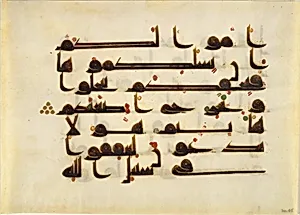
Folio from a Qur'an Manuscript
Unknown Artist
late 9th–early 10th century
Medium
Ink and gold on parchment
Dimensions
H. 13 1/8 in. (33.32 cm) W. 9 3/8 in. (23.8 cm)
Classification
Codices
Department
Islamic Art
Museum
Metropolitan Museum of Art, New York, NY
Credit
Gift of Rudolf M. Riefstahl, 1930
Accession Number
30.45
Rights
Public Domain
Tags
Art Historical Context
This exquisite folio from a Qur'an manuscript, dating to the late 9th or early 10th century offers a glimpse into the dawn of Islamic artistic tradition. Crafted by an unknown artist using ink gold on parchment—a medium prized for its durability and prestige before paper's widespread adoption—this single page measures about 13 by 9 inches. As part of a codex, or early bound book, it exemplifies the reverence for the Qur'an, Islam's holy scripture, which was meticulously copied by hand during the Abbasid era. The use of gold ink for diacritical marks and subtle illumination against bold black ink highlights masterful calligraphic techniques, likely in the angular Kufic script prevalent in early Qur'ans. These manuscripts were not mere texts but sacred objects, often produced in royal workshops like those in Baghdad, symbolizing piety, learning, and cultural flourishing amid the Islamic Golden Age. Housed in the Metropolitan Museum of Art's Islamic Art Department (gift of Rudolf M. Riefstahl, 1930), this folio invites visitors to appreciate the fusion of spirituality and artistry that defined medieval Islamic bookmaking, bridging faith and aesthetic innovation.