
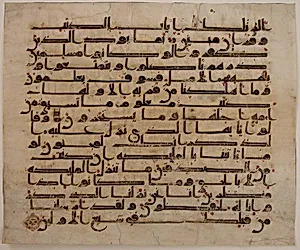
Folio from a Qur'an Manuscript
Unknown Artist
second half 8th century
Medium
Ink, opaque watercolor, and gold on parchment
Dimensions
Ht. 14 1/4 in. (36.1 cm) W. 11 7/8 in. (30.1 cm)
Classification
Codices
Department
Islamic Art
Museum
Metropolitan Museum of Art, New York, NY
Credit
Gift of Estate of Monir Shahroudy Farmanfarmaian, in memory of Dr. Abolbashar Farmanfarmaian, 2021
Accession Number
2021.94.3
Rights
Public Domain
Art Historical Context
This stunning folio from a Qur'an manuscript, dating to the second half of the 8th century, offers a glimpse into the dawn of Islamic artistic traditions. Created during the early Abbasid period, when the Islamic world was flourishing under caliphal patronage, such manuscripts were among the most revered objects in society. The Qur'an, Islam's holy book, was meticulously copied by hand, embodying spiritual devotion and scholarly precision. Measuring 14¼ × 11⅞ inches, this large parchment leaf would have been part of a grand codex, designed for communal recitation in mosques or madrasas. Crafted with ink for the flowing script—likely in the angular Kufic style typical of the era—opaque watercolors and gold add luminous splendor. Parchment, made from animal skin, was the premium medium before paper's widespread adoption, allowing for durability and a smooth surface ideal for intricate designs. The gold leaf, applied with exquisite control, catches the light to evoke divine radiance, while vibrant pigments highlight verse markers and decorative frames. These techniques reflect the fusion of artistry and piety, where scribes doubled as illuminators. Housed in the Metropolitan Museum of Art's Islamic Art department (gift of the Estate of Monir Shahroudy Farmanfarmaian, 2021), this folio underscores the Qur'an's role as a cultural cornerstone, influencing calligraphy and bookmaking for centuries. Visitors, marvel at its timeless elegance—a testament to faith rendered in gold.