
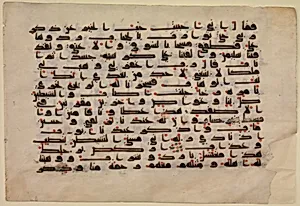
Folio from a Qur'an Manuscript
Unknown Artist
8th–9th century
Medium
Ink on parchment
Dimensions
H. 8 1/2 in. (21.6 cm) W. 5 3/4 in. (14.6 cm)
Classification
Codices
Department
Islamic Art
Museum
Metropolitan Museum of Art, New York, NY
Credit
Gift of Marilyn Jenkins, 1984
Accession Number
1984.504.1
Rights
Public Domain
Tags
Art Historical Context
This exquisite folio from a Qur'an manuscript, dating to the 8th–9th century, a glimpse into one of the earliest surviving examples of the Islamic holy book in codex form. Crafted ink on parchment—a medium prized for its durability and fine texture before paper's widespread adoption—this leaf measures a modest 8½ by 5¾ inches, designed for intimate study or recitation. Housed in the Metropolitan Museum of Art's Islamic Department, it was generously gifted by Marilyn Jenkins in 1984. In Islamic tradition, the Qur'an's text holds unparalleled sanctity, and its transcription elevated calligraphy to the pinnacle of artistic expression. Unknown scribes meticulously rendered the Arabic verses in an early script style, showcasing the precision and rhythm essential to conveying divine revelation. These manuscripts, produced during the Umayyad or early Abbasid eras, were often created in scriptoria across the Islamic world, from Damascus to Kufa, reflecting a burgeoning culture of book arts. As visitors, marvel at this fragile page bridges centuries, embodying faith, craftsmanship, and cultural devotion. Its survival underscores the reverence for the Qur'an, making it a treasured artifact in understanding early Islamic artistry.