
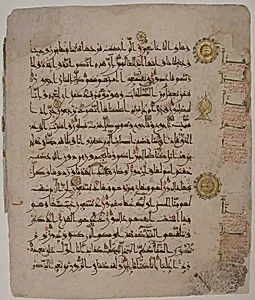
Folio from a Qur'an Manuscript
Unknown Artist
second half 10th century
Medium
Ink, opaque watercolor, and gold on paper
Dimensions
H. 14 1/4 in. (36.2 cm) W. 11 7/8 in. (30.2 cm)
Classification
Codices
Department
Islamic Art
Museum
Metropolitan Museum of Art, New York, NY
Credit
Rogers Fund, 1962
Accession Number
62.152.6
Rights
Public Domain
Tags
Art Historical Context
This exquisite folio from a Qur'an manuscript, dating to the second half of the 10th century, offers a glimpse into the golden age of early Islamic book arts. Crafted by an unknown scribe, it measures an impressive 14¼ by 11⅞ inches, typical of grand codices produced in regions like Iraq or Persia under Abbasid patronage. As part of the Metropolitan Museum of Art's Islamic Art collection (acquired via the Rogers Fund in 1962), it exemplifies the reverence for the Qur'an—the sacred text of Islam—rendered in the monumental Kufic script, an angular, bold style that dominated early manuscripts for its clarity and majesty. The medium of ink, opaque watercolor, and gold on paper highlights masterful techniques: precise black ink outlines the monumental letters, while vibrant watercolors and shimmering gold illuminate diacritical marks and decorative elements, creating a luminous effect that evokes divine light. This opulent decoration was not mere ornamentation but a visual prayer, elevating the written word to a sacred art form where calligraphy reigned supreme in Islamic culture, often surpassing figural representation. Such folios remind us of the Qur'an's centrality to Muslim life—memorized, recited, and venerated. Produced before printing revolutionized texts, they were laboriously hand-copied by skilled artisans, preserving the faith's oral and visual traditions across centuries. A true treasure for contemplation.