
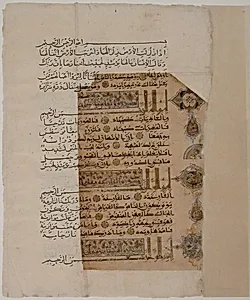
Folio from a Qur'an Manuscript
A.H. 531/ 1137 CE
Medium
Ink, gold, and opaque watercolor on paper
Dimensions
H. 7 11/16 in. (19.5 cm) W. 5 1/8 in. (13 cm)
Classification
Codices
Department
Islamic Art
Museum
Metropolitan Museum of Art, New York, NY
Credit
Louis E. and Theresa S. Seley Purchase Fund for Islamic Art and Rogers Fund, 1996
Accession Number
1996.294.3
Rights
Public Domain
Tags
Art Historical Context
This exquisite folio from a Qur'an manuscript, crafted by the calligrapher Muhammad al-Zanjani 1137 CE (A.H. 531), exemplifies the pinnacle of Islamic devotion during the medieval period. Measuring a compact 7 11/16 by 5 1/8 inches, this single page once formed part of a codex—a bound book format that revolutionized manuscript production in the Islamic world, making sacred texts more accessible than earlier scrolls. Produced amid the cultural flourishing of the Seljuk era, it reflects the era's emphasis on spiritual precision and beauty. Rendered in ink, gold, and opaque watercolor on paper, the folio showcases masterful calligraphy, likely in a refined Kufic or early cursive script, where letterforms dance with geometric harmony. Gold accents illuminate the verses, a technique symbolizing divine light (nur), while opaque watercolors add vibrant polychromy to diacritical marks and ornamentation. In Islamic art, where figurative imagery was eschewed in religious contexts, calligraphy reigned supreme as the noblest medium, transforming the word of God into visual poetry. Housed in the Metropolitan Museum of Art's Islamic Art Department, this leaf invites visitors to ponder the scribe's piety: each stroke a prayer, bridging 12th-century Persia or Iraq to our time. A testament to enduring reverence for the Qur'an, it highlights how art and faith intertwined to preserve and exalt the divine revelation.