
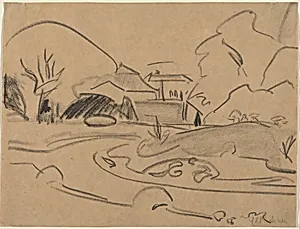
Footpaths and Pavilion in the Dresden Grosser Garten
c. 1909
Medium
black crayon on brown wove paper
Dimensions
overall: 33.1 x 43.6 cm (13 1/16 x 17 3/16 in.)
Classification
Drawing
Department
CG-W
Museum
National Gallery of Art, Washington, D.C.
Credit
Epstein Family Fund
Accession Number
1982.71.1
Rights
Public Domain
Art Historical Context
Ernst Ludwig Kirchner's *Footpaths and Pavilion in Dresden Grosser Garten*c. 1909) captures a serene moment in one of Dresden's most beloved public parks, the sprawling Grosser Garten. Rendered in bold black crayon on warm brown wove paper (.1 x 43.6 cm), this showcases winding footpaths leading toward a distant pavilion, evoking the atmosphere of early 20th-century urban. As a foundational work from Kirchner's Dresden period, it reflects his fascination with everyday landscapes transformed through personal vision. A pioneer of German Expressionism and co-founder of the revolutionary artist group Die Brücke (The Bridge) in 1905, Kirchner rejected academic naturalism for raw, emotional intensity. Here, his dynamic crayon strokes—loose, energetic, and textured—convey movement and vitality, hallmarks of the group's woodcut-inspired aesthetic. Though monochromatic, the brown paper's earthy tone adds depth, simulating shadow and atmosphere without color. This intimate drawing, now in the National Gallery of Art thanks to the Epstein Family Fund, highlights Kirchner's mastery of quick-sketch techniques, bridging his studio experiments with the vibrant street life that fueled Die Brücke's modernist rebellion. Visitors will appreciate how it distills the park's tranquility into a powerful, expressive statement.
About the Artist
Ernst Ludwig Kirchner · 1880–1938
Ernst Ludwig Kirchner was born on May 6, 1880, in Aschaffenburg, Germany, to parents Ernst and Maria Kirchner, part of a family of Prussian descent that frequently relocated due to his father's career as a chemical technician. After early schooling in various towns, he studied architecture at the Königliche Technische Hochschule (Technical University) in Dresden from 1901 to 1905, taking courses i...