
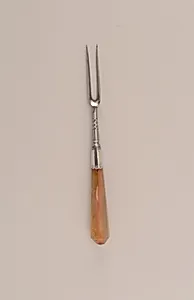
Fork with Eight-Paneled Agate Handle
late 17th century
Classification
cutlery
Department
Smithsonian Collection
Museum
Smithsonian American Art Museum
Credit
Gift of Mrs. Francis B. Lothrop, Mrs. George Batchelder, and Gordon Abbott, Sr.
Accession Number
1957-29-4-b
Rights
Public Domain
About this artwork
Research in Progress
Art Historical Context
Step into the elegance of late 17th-century London dining with this exquisite *Fork with Eight-Paneled Agate Handle*, crafted by William Boswell, a skilled artisan active in the English capital during that opulent era. Produced around the Restoration period, when King Charles II's court popularized lavish tableware, this piece exemplifies the growing sophistication of cutlery. Forks, once a novelty from Italy, were becoming status symbols among the elite, signaling refined manners and wealth. The handle's standout feature is its eight-panel agate construction—a semi-precious stone prized for its banded beauty and durability. Likely faceted or carved into geometric panels, it showcases the meticulous lapidary techniques of the time, blending natural luxury with silversmith precision (though the metal medium awaits further research). Such embellishments turned everyday utensils into heirlooms, reflecting Baroque tastes for ornamentation and exotic materials. Now in the Smithsonian American Art Museum's collection, generously gifted by Mrs. Francis B. Lothrop, Mrs. George Batchelder, and Gordon Abbott, Sr., this fork invites us to ponder the artistry of daily life. As research progresses, it stands as a tangible link to England's golden age of craftsmanship. (198 words)