
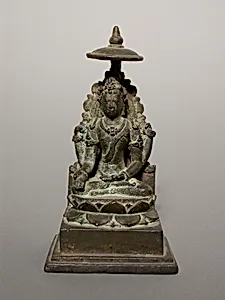
Four-Armed Bodhisattva
9th/10th century
Medium
Bronze
Dimensions
10.8 × 5.8 × 4.6 cm (4 1/4 × 2 1/4 × 1 3/4 in.)
Classification
bronze
Department
Arts of Asia
Museum
Art Institute of Chicago
Accession Number
156609
Rights
Public Domain
Art Historical Context
This exquisite bronze sculpture of a Four-Armed Bodhisattva dating to the 9th or 10th century, the compassionate ideals of Mahayana Buddhism. Bodhisattvas, enlightened beings who postpone nirvana to aid others, often depicted with multiple arms to symbolize their boundless ability to perform acts of mercy simultaneously—holding attributes like lotuses for purity or ritual implements for protection. Crafted at a modest scale of just 10.8 × 5.8 × 4.6 cm, this was likely a portable devotional object, treasured by pilgrims or used in private meditation rituals across Asia. The use of bronze highlights advanced metallurgical techniques of the era, probably employing the lost-wax casting method common in Indian, Nepalese, or Southeast Asian workshops. This allowed for the fine detailing of the deity's serene expression, flowing garments, and dynamic posture, capturing a sense of graceful divinity. Produced during a golden age of Buddhist art, when tantric traditions flourished, the sculpture reflects the spread of esoteric Buddhism amid royal patronage and cultural exchange along the Silk Roads. Today, housed in the Art Institute of Chicago's Arts of Asia department, this rare survivor offers a tangible link to ancient spiritual devotion, inviting visitors to ponder the enduring power of compassion in a turbulent world.
About the Artist
Unknown
The artist designated as "Unknown" in our virtual museum's collection exemplifies a poignant chapter in art history: creators whose identities have faded into obscurity despite the enduring power of their work. With only one known artwork attributed to them in our holdings, this figure represents countless anonymous hands that shaped visual culture across centuries. Museums worldwide, including th...