
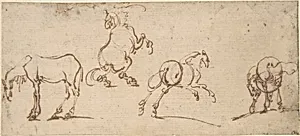
Four Studies of Horses
16th century
Medium
Pen and brown ink
Dimensions
2 3/8 x 5 1/4 in. (6 x 13.4 cm)
Classification
Drawings
Department
Drawings and Prints
Museum
Metropolitan Museum of Art, New York, NY
Credit
Anonymous Gift, 1996
Accession Number
1996.511
Rights
Public Domain
Tags
Art Historical Context
Jacques Callot’s “Four Studies of Horses” captures the artist’s keen eye for movement and anatomy in a compact pen-and-brown-ink drawing from the 16th century. Measuring just 2 ⅜ by 5 ¼ inches, the sheet likely served as a private study page, allowing Callot to quickly record the varied poses, musculature, and spirited energy of horses observed from life. Such sketches reveal the working methods of an artist celebrated for his intricate etchings of court ceremonies, battles, and everyday scenes. Horses held central importance in 16th-century European society, symbolizing power, nobility, and military might. Callot’s economical yet lively line work demonstrates how even the smallest drawings could inform larger compositions, translating observed motion into the dynamic prints for which he became renowned. Today, this delicate study resides in the Metropolitan Museum of Art’s Department of Drawings and Prints, offering visitors a rare look at the quiet, preparatory moments behind a master draftsman’s celebrated body of work.
About the Artist
Jacques Callot · 1592–1635
Jacques Callot (1592–1635) was a French printmaker and draftsman from the Duchy of Lorraine, widely regarded as one of the first great artists to practice the graphic arts exclusively. His more than 1,400 etchings chronicled the breadth of 17th-century life, from Medici court festivities to the brutal realities of warfare. Callot revolutionized etching through technical innovations including the é...