
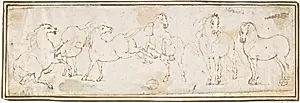
Six Horses
1624–63
Medium
Pen and brown ink. Framing lines in pen and brown ink on mount
Dimensions
2-15/16 x 9-3/4 in. (7.5 x 24.7 cm)
Classification
Drawings
Department
Drawings and Prints
Museum
Metropolitan Museum of Art, New York, NY
Credit
Gift of Cornelius Vanderbilt, 1880
Accession Number
80.3.319
Rights
Public Domain
Tags
Art Historical Context
Francesco Allegrini’s *Six Horses* captures the grace and energy of its subjects through the fluid lines of pen and brown ink. Created between 1624 and 1663, this small yet lively drawing measures just under three inches high and nearly ten inches wide, giving it an almost frieze-like quality that emphasizes the animals’ rhythmic procession across the page. The medium allows for quick, expressive strokes that convey movement and form with remarkable economy, a technique often favored by artists for preparatory studies or spontaneous observations. Horses frequently appear in Baroque-era works as symbols of power, speed, and nobility, and Allegrini’s delicate rendering suggests he was exploring these qualities in a compact format. The drawing’s horizontal orientation and careful framing lines on the mount indicate it was likely intended as a finished study or a piece for a collector’s album rather than a large-scale painting. Today, this work resides in the Metropolitan Museum of Art’s Department of Drawings and Prints, having entered the collection as a gift from Cornelius Vanderbilt in 1880. Its modest size invites close looking, rewarding viewers with the intimate pleasure of seeing an artist’s hand at work.
About the Artist
Francesco Allegrini · 1615–1679
Francesco Allegrini (c. 1615/20–after 1679), born likely in Rome to the painter Flaminio Allegrini from Cantiano near Gubbio, emerged from a family of artists that included his sister, Anna Angelica Allegrini. He trained under Giuseppe Cesari, known as the Cavalier d’Arpino, around 1638–40, before entering the studio of Pietro da Cortona, whose dynamic Baroque style profoundly shaped his own. Elec...