
Horses
1624–63
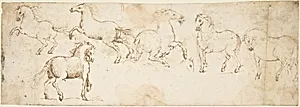
Medium
Pen and brown ink. Framing lines in pen and brown ink on mount
Dimensions
3-5/8 x 10-1/2 in. (9.2 x 26.7 cm)
Classification
Drawings
Department
Drawings and Prints
Museum
Metropolitan Museum of Art, New York, NY
Credit
Gift of Cornelius Vanderbilt, 1880
Accession Number
80.3.316
Rights
Public Domain
Tags
Art Historical Context
Francesco Allegrini’s *Horses* is a compact yet lively study created between 1624 and 1663, when the Italian artist was active in Rome and central Italy. Executed in pen and brown ink, the drawing’s elongated format—roughly three and a half by ten and a half inches—suggests Allegrini was exploring movement and rhythm rather than a finished composition. Quick, confident strokes convey the animals’ muscular forms and implied motion, revealing the Baroque interest in energy and naturalism. Drawings of this type were essential working tools for seventeenth-century artists. Allegrini likely used the sheet to record observations from life or to prepare motifs for larger frescoes and paintings featuring battles or processions, themes popular with his patrons. The medium’s immediacy allowed rapid experimentation with poses and anatomy before committing to costly canvas or plaster. Acquired by the Metropolitan Museum in 1880 as part of Cornelius Vanderbilt’s generous gift, the sheet now belongs to the museum’s renowned collection of drawings and prints. Small in scale yet rich in vitality, it offers visitors an intimate glimpse into the creative process behind Baroque art.
About the Artist
Francesco Allegrini · 1615–1679
Francesco Allegrini (c. 1615/20–after 1679), born likely in Rome to the painter Flaminio Allegrini from Cantiano near Gubbio, emerged from a family of artists that included his sister, Anna Angelica Allegrini. He trained under Giuseppe Cesari, known as the Cavalier d’Arpino, around 1638–40, before entering the studio of Pietro da Cortona, whose dynamic Baroque style profoundly shaped his own. Elec...