
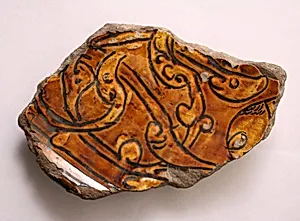
Fragment
Unknown Artist
14th–15th century
Medium
Earthenware; incised decoration through white slip and coloring under transparent glaze
Classification
Ceramics
Department
Islamic Art
Museum
Metropolitan Museum of Art, New York, NY
Credit
Rogers Fund, 1908
Accession Number
08.256.95
Rights
Public Domain
Art Historical Context
This enchanting *Fragment* from the 14th–15th century offers a glimpse into the refined world of Islamic ceramics, housed in the Metropolitan Museum of Art's Islamic Art department. Crafted from earthenware, it exemplifies the exquisite pottery traditions of the medieval Islamic world, where everyday objects and architectural tiles were elevated to art through masterful techniques. Acquired through the Rogers Fund in 1908, this piece survives as a testament to the durability and beauty of these fragile creations. The artwork's standout feature is its incised decoration, achieved by scratching designs through a layer of white slip to reveal the reddish body beneath, then enhanced with colored pigments and sealed under a transparent glaze. This sgraffito-like method, popular in regions like Persia and Syria during this era, allowed artisans to create intricate patterns—perhaps floral motifs or geometric forms—that shimmered with iridescent depth once fired. The transparent glaze not only protected the surface but also intensified the vibrant hues, showcasing the technical ingenuity that made Islamic ceramics coveted across continents. Though incomplete, this fragment highlights the cultural significance of pottery in Islamic society, blending utility with spiritual symbolism through non-figural designs that adhered to aniconic traditions. It invites visitors to appreciate the anonymous genius of medieval potters, whose innovations influenced global ceramics for centuries.