
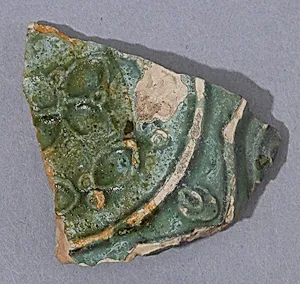
Fragment
Unknown Artist
9th century
Medium
Earthenware; molded decoration, glazed
Classification
Ceramics
Department
Islamic Art
Museum
Metropolitan Museum of Art, New York, NY
Credit
Gift of Mr. and Mrs. Wendell M. Hastings, 1960
Accession Number
60.23.31
Rights
Public Domain
Art Historical Context
This exquisite *Fragment* from the th century offers a glimpse into the vibrant world of early Islamic ceramics. Crafted from earthenware with molded decoration and a glossy glaze, it hails from the Islamic Golden Age under the Abbasid Caliph, a period of remarkable cultural and artistic flourishing across the Middle East and beyond. Such fragments often survived from larger vessels used in everyday life, trade, or even elite dining, highlighting ceramics' role as an accessible yet sophisticated art form. The piece showcases innovative techniques: molding allowed artisans to create intricate raised designs—likely floral, geometric, or calligraphic motifs emblematic of Islamic aesthetics—before applying glaze for a luminous finish. This method, perfected in regions like Iraq and Persia, marked a shift from simpler pottery traditions, influencing global ceramics for centuries. The unknown artist's skill reflects the collaborative workshops where master potters passed down secrets, blending utility with beauty. Housed in the Metropolitan Museum of Art's Islamic Art Department (gift of Mr. and Mrs. Wendell M. Hastings, 1960), this fragment invites us to ponder the ingenuity of artisans whose work bridged cultures along the Silk Road. Though small, it embodies the enduring elegance of 9th-century Islamic design.