
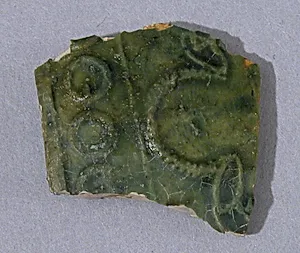
Fragment
Unknown Artist
9th century
Medium
Earthenware; molded decoration, glazed
Classification
Ceramics
Department
Islamic Art
Museum
Metropolitan Museum of Art, New York, NY
Credit
Gift of Mr. and Mrs. Wendell M. Hastings, 1960
Accession Number
60.23.26
Rights
Public Domain
Art Historical Context
This exquisite earthenware fragment from the 9th century offers a glimpse into the vibrant world of early Islamic ceramics. Crafted during the Abbasid Caliphate—a golden age of Islamic art and science—this piece exemplifies the innovative techniques emerging in regions like Iraq and Persia. The molded decoration, created by pressing clay into intricately carved molds before firing, allowed artisans to produce repeating patterns with remarkable precision, often featuring geometric motifs or stylized flora that symbolized paradise gardens in Islamic culture. The application of a glossy glaze not only enhanced the fragment's durability and waterproof quality—ideal for everyday vessels like bowls or tiles—but also created a luminous surface that caught the light in mosques and homes. As a surviving shard, it hints at the sophistication of these objects, which bridged utilitarian craft and artistic expression, influencing pottery traditions across the Islamic world and beyond. Generously gifted to the Metropolitan Museum of Art by Mr. and Mrs. Wendell M. Hastings in 1960, this fragment invites us to appreciate the anonymous mastery of medieval potters, whose work continues to illuminate the cultural splendor of the 9th century.