
Fragment
Unknown Artist
12th–13th century
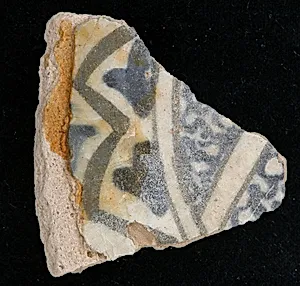
Medium
Stonepaste; slip painted, glazed
Dimensions
H. 3/4 in. (1.9 cm) W. 2 9/16 in. (6.5 cm) D. 2 1/2 in. (6.4 cm) Wt. 1.5 oz. (42.5 g)
Classification
Ceramics
Department
Islamic Art
Museum
Metropolitan Museum of Art, New York, NY
Credit
Gift of Mr. and Mrs. Wendell M. Hastings, 1960
Accession Number
60.23.55
Rights
Public Domain
Art Historical Context
This delicate ceramic fragment, dating to the 12th–13th century, offers a glimpse into the sophisticated world of Islamic art. Crafted frompaste—a composite of quartz, clay, and frit that mimicked the prized translucency of Chinese porcelain—it hails from the medieval Islamic heartlands, likely regions like Iran or Syria. At just 3/4 inch high and weighing a mere 1.5 ounces, this tiny shard (H. 3/4 in.; W. 2 9/16 in.; D. 2 1/2 in.) may once have adorned a vessel, tile, or architectural element, evoking the opulence of Abbasid or Seljuk-era courts. The artwork's medium shines through its techniques: slip painting, where pigmented liquid clay was applied to create intricate designs before a glossy glaze was fired on, yielding vibrant colors and a smooth, reflective surface. This method, perfected in Islamic workshops, allowed for bold motifs—often geometric patterns, florals, or calligraphy—that symbolized paradise gardens or divine order. Stonepaste's durability made it ideal for everyday luxury items exported across trade routes, blending utility with artistry. Preserved through the generous gift of Mr. and Mrs. Wendell M. Hastings in 1960, this fragment in the Metropolitan Museum of Art's Islamic Art Department underscores the era's ceramic innovation. Though incomplete, it whispers of a cultural flourishing where potters pushed material boundaries, influencing global ceramics for centuries. A testament to artistry's endurance!