
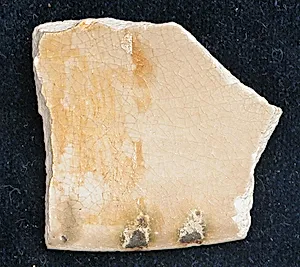
Fragment
Unknown Artist
12th–13th century
Medium
Stonepaste; slip painted and glazed
Dimensions
H. 1 5/8 in. (4.1 cm) W. 1 11/16 in. (4.3 cm) D. 3/8 in. (1 cm) Wt. 0.5 oz. (14.2 g)
Classification
Ceramics
Department
Islamic Art
Museum
Metropolitan Museum of Art, New York, NY
Credit
Gift of Mr. and Mrs. Wendell M. Hastings, 1960
Accession Number
60.23.77
Rights
Public Domain
Art Historical Context
This delicate ceramic fragment, dating to the 12th–13th century, hails from the vibrant world of Islamic art, where artisans mastered innovative techniques to create luminous pottery. Crafted from stonepaste—a composite of quartz, clay, and frit (glass powder)—it exemplifies a breakthrough material developed in the eastern Islamic lands, such as Iran or Syria. This fritware allowed for thin, durable bodies that could support vibrant glazes, mimicking the prized Chinese porcelain while enabling bold colors and intricate designs. Slip-painted and glazed, the fragment likely once adorned a vessel, tile, or architectural element, with motifs painted in liquid clay slip before firing under a glossy sheen. At just 1 5/8 inches high and weighing a mere half ounce, it whispers of the exquisite refinement of Seljuk-era ceramics, a golden age when potters pushed the boundaries of form and decoration. Though incomplete, it captures the era's love for geometric patterns, floral motifs, or calligraphy, symbols of paradise gardens and divine order. Now at the Metropolitan Museum of Art, gifted by Mr. and Mrs. Wendell M. Hastings in 1960, this tiny survivor invites us to marvel at the ingenuity of anonymous craftsmen whose work bridged utility and beauty across centuries.